


Why Children Who Learn Music Often Perform Better in Reading and Math
A research-based look at how music education supports academic success
Music education has long been valued for creativity and artistic expression. But over the past few decades, researchers have discovered something even more compelling: children who study music often perform better in core academic subjects such as reading and math.
From neuroscience to large-scale educational studies, evidence suggests that music training strengthens cognitive skills that are essential for learning. In this article, we’ll explore what science says about music education and academic achievement, why the connection exists, and how parents can use music lessons to support their child’s development.
Research Shows Music Students Often Perform Better Academically
A number of large-scale studies have examined the relationship between music education and academic achievement.
One widely cited study conducted by psychologist E. Glenn Schellenberg followed thousands of students and found that children who took music lessons demonstrated higher IQ scores and improved academic performance compared to those who did not receive music instruction. These cognitive benefits were still observable years later, suggesting that music training can have lasting effects on a child’s intellectual development.
Similarly, research published in the Journal of Educational Psychology examining more than 112,000 students found that students enrolled in music programs consistently scored higher in mathematics, science, and English compared to students who were not involved in music education. Students who remained involved in music throughout high school were found to be nearly one academic year ahead of their peers in several subjects.
In another major analysis, researchers reviewed 55 studies involving nearly 78,000 students and concluded that music education had a measurable positive impact on math learning. The analysis found that music-based instruction helped students better understand mathematical concepts such as fractions, ratios, and patterns.
Why Music Helps Children Learn Math and Reading
The connection between music and academic success isn’t just coincidence. Researchers have identified several cognitive mechanisms that explain the relationship.
1. Music Strengthens Pattern Recognition
Both music and mathematics rely heavily on patterns and sequences.
Musical rhythms follow structured timing patterns.
Mathematical formulas rely on numerical patterns and relationships.
When children learn music, they train their brains to recognize patterns faster and more accurately, a skill that directly supports mathematical reasoning.
2. Music Improves Memory and Attention
Learning an instrument requires students to:
Memorize notes and rhythms
Focus attention during practice
Coordinate multiple skills simultaneously
These activities strengthen working memory and concentration, two cognitive abilities essential for reading comprehension and problem-solving.
3. Music Enhances Language Processing
Music training improves auditory discrimination, the brain’s ability to distinguish subtle differences in sound.
A study on young children receiving piano lessons found that music training improved their ability to distinguish speech sounds, which is a key skill in language development and reading.
Better sound processing helps children:
Recognize phonics
Decode words
Improve reading fluency
4. Music Engages Multiple Brain Regions
Playing music is one of the few activities that activates almost every region of the brain at once, including areas responsible for:
Motor coordination
Memory
Emotion
Language
Mathematical reasoning
This whole-brain engagement helps create stronger neural connections, which can benefit learning across multiple subjects.
Music and Mathematics: A Natural Connection
Music and math share several structural similarities.
For example:
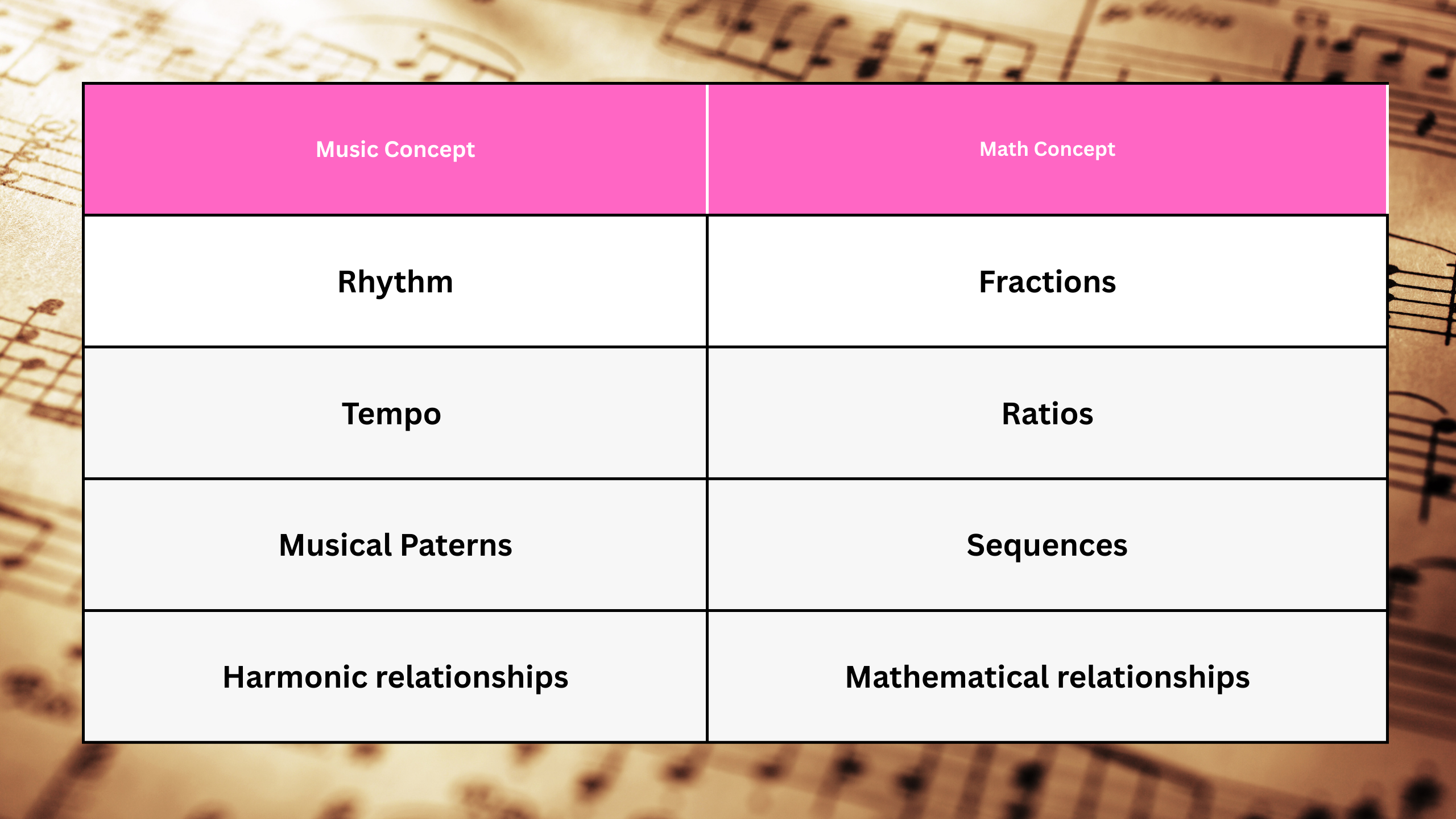
Because of these similarities, learning music can strengthen the same mental processes used in mathematical thinking.
Researchers note that arithmetic concepts such as fractions and ratios are fundamental in musical rhythm, making music a natural way to reinforce math skills.
Benefits of Music Education Beyond Academics
While improved test scores are impressive, the benefits of music education extend far beyond math and reading. Children who study music often develop stronger discipline and persistence as they learn to practice regularly and work toward mastering new skills. Music lessons can also build self-confidence as students perform and achieve milestones in their learning journey. In addition, studying music encourages creativity and provides a meaningful outlet for emotional expression. When children participate in group lessons or ensembles, they also develop stronger social skills as they learn to collaborate, listen, and perform with others. Through consistent practice and gradual progress, music education teaches children how to set long-term goals and stay committed to achieving them valuable skills that can benefit many areas of life.
When Should Children Start Music Lessons?
Research suggests that early exposure to music can provide some of the strongest cognitive benefits, particularly during the elementary school years when the brain is highly adaptable and developing rapidly. However, it is important to remember that it is never too late for a child to begin learning music. Children of all ages can benefit from music lessons, as they help improve concentration, strengthen memory, encourage creativity, and support overall academic development.
Give Your Child the Advantage of Music Education
The research is clear: music education supports cognitive development and academic achievement. Children who learn music often develop stronger reading, math, and learning skills that can benefit them throughout their education.
At Nova Music School, we are passionate about helping students grow not only as musicians—but as confident, capable learners.
Our experienced teachers offer lessons in:
Piano
Voice
Violin
Guitar
Drums
Saxophone
Whether your child is just beginning or already loves music, our programs are designed to build skills, confidence, and creativity in a supportive environment.
🎵 Start Your Child’s Musical Journey Today
Give your child the lifelong benefits of music education.
Book a trial lesson at Nova Music School today and discover how music can inspire learning, confidence, and academic success.
👉 Visit novamusicschool.co to enroll or schedule your first lesson.
Your child’s musical journey starts here. 🎶